Moving to Colorado in 2026: What You Need to Know Before You Move
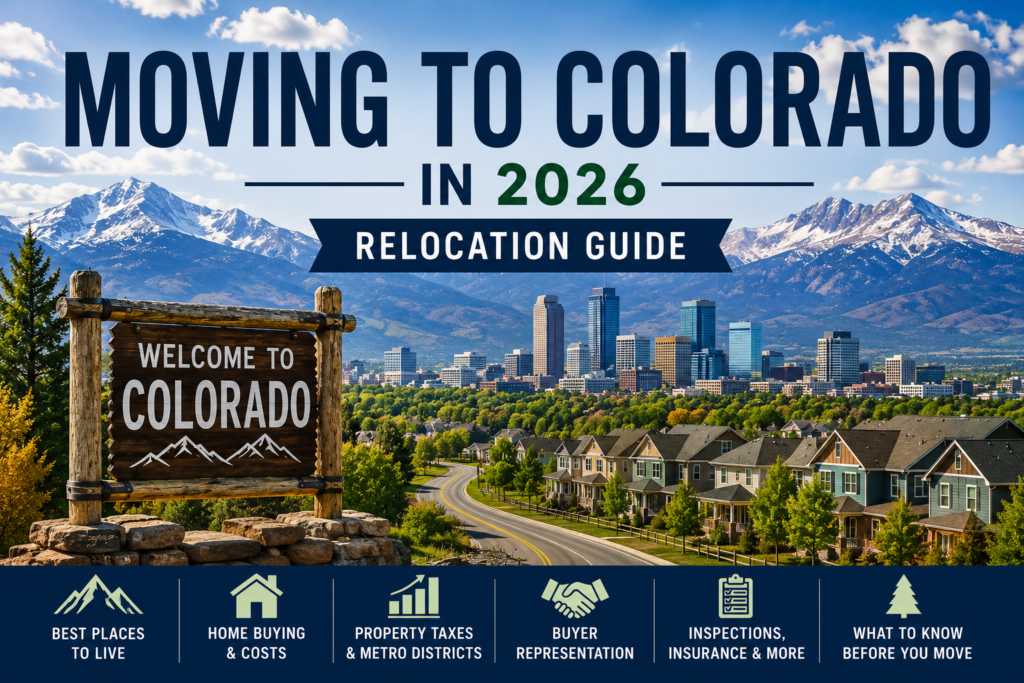
Thinking about moving to Colorado in 2026?
You’re definitely not the only one looking.
Colorado’s population passed 6 million people in 2025, and people continue to consider the state for its mountain access, outdoor recreation, employment opportunities and huge variety of communities.
But deciding you want to move to Colorado is the easy part.
Figuring out where in Colorado you should live is a completely different question.
Denver? Aurora? Parker? Castle Rock? Boulder? Erie? Berthoud? Loveland? Fort Collins? Windsor? Greeley? Estes Park?
Those places can offer dramatically different home prices, commutes, housing styles, property taxes, special taxing districts and access to the things that brought you to Colorado in the first place.
If you’re relocating to Colorado, this guide will help you understand some of the biggest decisions to make before you start looking at houses.
And if you want help narrowing down the options, you don’t have to figure it all out from hundreds or thousands of miles away.
I’m Tina Biunno, a Colorado Broker Associate and REALTOR® with eXp Realty. I’ve spent nearly 30 years in real estate and mortgage lending, including working as a loan originator, senior underwriter, manager, auditor and trainer. I’ve made the final yes-or-no decision on thousands of loans and appraisals.
That background means when I’m helping someone relocate, I’m not just looking for a house that photographs well.
I’m looking at the bigger picture.
Is Colorado Still a Good Place to Move in 2026?
That depends entirely on why you’re moving and what you expect Colorado to look like.
Colorado’s population reached approximately 6.01 million residents in 2025, according to the U.S. Census Bureau.
But statewide population numbers don’t tell you where you should live.
One of the biggest mistakes people make when relocating here is thinking of Colorado as one giant Denver suburb with mountains in the background.
It isn’t.
You can live in a major metro area, an established Denver suburb, a rapidly growing Front Range community, a Northern Colorado college town, a smaller town surrounded by open land or a mountain community where elk wandering through town isn’t exactly breaking news.
The tradeoffs can be substantial.
Before choosing a city, start with questions like:
- What is your realistic housing budget?
- Where will you work?
- How often do you need to commute?
- Do you want newer construction or an established neighborhood?
- How much house and land do you want?
- How important is mountain access?
- Are property taxes or special taxing districts a concern?
- Do you want an HOA, or would you prefer to avoid one?
- Do you need proximity to Denver International Airport?
- Are you comfortable driving in winter conditions?
- Do you want city amenities or more breathing room?
Those answers usually narrow Colorado down surprisingly quickly.
How Much Does It Cost to Buy a House in Colorado in 2026?
There really isn’t one useful answer to the question:
“What does a house cost in Colorado?”
Colorado isn’t one housing market.
Your buying power can look completely different depending on whether you’re searching in Aurora, Boulder, Erie, Greeley, Fort Collins, Castle Rock, Estes Park or somewhere in between.
Even two homes with similar prices can have very different monthly payments because purchase price isn’t the only number that matters.
When comparing Colorado homes, look at the complete picture:
Purchase price + property taxes + HOA dues + special district taxes + homeowners insurance + financing costs = the number that actually matters.
A $600,000 home isn’t automatically more affordable than a $625,000 home.
I’ve spent enough years on the lending side of real estate to tell you this:
Shop the payment and the entire financial picture, not just the list price.
Where Should You Live in Colorado?
If you’re moving from out of state, start with regions and communities rather than individual houses.
Here are some of the Front Range areas relocation buyers commonly consider.
Denver
Denver puts you in the center of the metro area with access to major employment centers, entertainment, restaurants, professional sports and established neighborhoods.
Housing can range from condos and historic homes to newer infill construction.
Buyers who want newer homes, larger lots or more house for their budget frequently expand their search outside Denver proper.
Aurora
Aurora is enormous geographically, which is something people moving here don’t always realize.
Depending on where you’re looking, you’ll find established neighborhoods, condos and townhomes, newer subdivisions and substantial new construction.
Aurora can be particularly worth exploring if proximity to Denver International Airport, the Anschutz Medical Campus or the eastern Denver metro area matters to you.
But don’t evaluate “Aurora” as if it’s one neighborhood.
Location within the city matters tremendously.
Parker
Parker sits southeast of Denver and offers a combination of established communities and newer construction.
Buyers considering Parker frequently compare it with Castle Rock, Aurora and other southeast Denver-area communities, especially when they want suburban housing while maintaining access to the Denver metro area.
Castle Rock
Castle Rock is south of Denver along I-25 and has experienced extensive residential development.
You’ll find everything from attached housing to large homes and luxury properties.
If you’re commuting north toward Denver, however, don’t look at a map and assume the drive time.
Colorado traffic has opinions.
Check the commute during the hours you’ll actually be driving.
Erie
Erie has grown considerably and has become an area many buyers consider when looking between Denver, Boulder and Northern Colorado.
You’ll find substantial newer construction, master-planned communities and higher-end homes.
One thing I specifically tell buyers to investigate in newer Colorado developments is the property’s tax structure and any special taxing districts.
Two similarly priced homes can have meaningfully different tax bills.
Boulder
Boulder provides proximity to the University of Colorado, major employers, restaurants, trails and the foothills.
It is also generally one of the more expensive housing markets along the Front Range, which causes some buyers to broaden their searches into surrounding communities.
If Boulder is your employment destination, don’t automatically assume you have to live inside Boulder city limits.
Berthoud
Berthoud sits between the Denver metro area and Northern Colorado and retains a smaller-town setting despite significant development.
There are established homes, acreage properties and new construction in and around the area.
And yes, there are still some new-construction opportunities in Northern Colorado that aren’t located within a metro taxing district.
You just need to know where to look.
Loveland
Loveland sits south of Fort Collins and provides access to Northern Colorado as well as routes toward Rocky Mountain National Park.
The housing stock ranges from established neighborhoods to newer communities and properties with more land as you move outside the central parts of town.
Loveland is worth comparing directly with Fort Collins, Berthoud and Windsor rather than evaluating any one of them in isolation.
Fort Collins
Fort Collins is home to Colorado State University and has a substantial employment, restaurant, brewery and recreation scene.
Housing includes older central neighborhoods, condos, suburban developments and newer construction around the edges of the city.
Buyers relocating here should compare Fort Collins with nearby Loveland, Windsor, Timnath and Wellington because your housing options can change significantly within a relatively short distance.
Windsor
Windsor has experienced extensive residential development and offers significant newer construction.
Its location between Fort Collins, Loveland and Greeley makes it interesting for buyers who need access to multiple parts of Northern Colorado.
Again, pay attention to taxes and special districts when comparing newer communities.
Greeley
Greeley deserves more attention from relocation buyers than it sometimes gets.
For buyers prioritizing housing affordability and space, Greeley can provide options that may be difficult to find at the same price closer to Denver or Boulder.
It also has its own employment base and is home to the University of Northern Colorado.
Don’t eliminate it simply because it isn’t a Denver suburb.
Estes Park
Estes Park is an entirely different Colorado experience.
It’s the gateway to Rocky Mountain National Park, and housing can include primary residences, condos, cabins, mountain properties and second homes.
But mountain real estate deserves additional due diligence.
Access, terrain, insurance, utilities, wildfire considerations, road maintenance and property-specific conditions can matter much more than they might with a typical suburban home.
If your Colorado dream involves waking up to mountain views and occasionally waiting for elk to get out of the road, Estes Park belongs on the list.
Moving to Colorado? Don’t Ignore Property Taxes and Metro Districts
This is one of the Colorado real estate topics I wish more out-of-state buyers knew about before falling in love with a house.
Colorado has thousands of special governmental districts, and some newer developments may be located within metropolitan districts or other special taxing districts.
These districts can help finance infrastructure and services within a development.
For the buyer, however, the important question is simple:
What will I actually pay?
Don’t compare two homes based solely on their listing prices.
Ask about the property’s tax history, current tax information, HOA obligations and applicable special districts.
If you’re considering new construction, this becomes particularly important.
Buying New Construction in Colorado
Colorado has significant new-home construction, particularly along the Front Range.
New construction can offer:
- Builder warranties
- Modern layouts
- Energy-efficient features
- Newer systems and appliances
- Community amenities
- Builder financing incentives
- Closing-cost incentives
- Interest-rate incentives
But here’s the part buyers sometimes miss:
The builder’s salesperson represents the builder—not you.
You can have your own real estate brokerage representing your interests in the purchase.
I strongly recommend understanding the builder contract, financing incentives, taxes, metro districts, HOA structure, inspection options, lot premiums and what is actually included in the advertised price.
That gorgeous model home may contain a long list of upgrades with extra costs.
The sign outside might say:
“From the $500s.”
The model you’re standing inside may be nowhere near that number.
Ask.
Do Colorado Buyers Have to Pay Their Buyer Brokerage Fee Out of Pocket?
This is one of the biggest misconceptions I hear from people moving to Colorado from other states.
Some buyers arrive believing that if they want their own real estate brokerage representing them, they automatically have to pay the entire buyer brokerage fee out of pocket.
That’s not necessarily the case in Colorado.
Buyer-broker compensation is negotiable. In Colorado, we can write an offer requesting that the seller pay the buyer brokerage compensation, and in my experience, it is very common for sellers in Colorado to agree to pay buyer brokerage compensation as part of the transaction.
That doesn’t mean a seller is required to pay it, and seller payment is never guaranteed.
Like price, closing costs and other terms of an offer, buyer brokerage compensation can be requested and negotiated as part of the transaction.
Colorado’s Real Estate Commission-approved residential purchase contract provides a mechanism for brokerage compensation to be paid by the seller, buyer or another party, depending on what is negotiated.
That’s an important distinction for anyone moving here from another state.
I don’t want a buyer giving up professional representation—or assuming they can’t afford it—because they heard that buyers now automatically have to pay their brokerage fee entirely out of pocket.
You still have the ability to obtain buyer representation and ask the seller to pay your buyer brokerage compensation. And in Colorado, seller-paid buyer brokerage compensation continues to be a common way transactions are structured.
Whether a particular seller agrees, how much they agree to pay and how the compensation is structured will depend on the individual transaction, your buyer agreement, your offer and any applicable financing requirements.
Colorado’s Commission-approved buyer agreement also makes clear that brokerage compensation is not set by law and is fully negotiable.
So if you’re moving to Colorado and someone has told you:
“Buyers have to pay their own agent now.”
Don’t automatically assume that means you’ll have to bring thousands of additional dollars out of pocket to have your own representation.
Talk to me first.
We’ll look at the homes you’re considering, your financing and current market conditions. I’ll explain what we can request from the seller and how the numbers could work before you decide whether to make an offer.
Colorado Home Inspections: Radon Matters Here
If you’re moving from another state, radon may not be something you’ve dealt with before.
It is in Colorado.
According to the Colorado Department of Public Health and Environment, approximately half of Colorado homes have radon levels at or above the EPA action level of 4.0 picocuries per liter (pCi/L).
That’s why radon testing is something Colorado buyers should understand as part of their inspection and due-diligence decisions.
A house doesn’t have to be old to have elevated radon.
It doesn’t have to have a basement.
And you cannot determine whether a house has elevated radon by looking at it.
Test it.
Other Colorado Home-Buying Issues Relocation Buyers Should Know About
Colorado homes come with some location-specific considerations.
Depending on the property, you’ll want to investigate things such as:
Hail and Roof Condition
Colorado gets hail.
Roof age, condition and insurability can therefore become important parts of a transaction.
Don’t assume that because a roof looks fine from the driveway, you’re done investigating it.
Homeowners Insurance
Talk with an insurance professional before your applicable insurance deadline, particularly when considering properties with older roofs or homes in areas with increased wildfire exposure.
Insurance availability and premiums can affect the true affordability of a home.
Wildfire Risk
For mountain, foothill and some rural properties, wildfire exposure can affect insurance and property-maintenance considerations.
Investigate the specific property rather than making assumptions based solely on the city name.
Wells and Septic Systems
Once you move outside more densely developed areas, private wells and septic systems become more common.
Those properties require different due diligence than a typical suburban home connected to municipal water and sewer.
Snow and Road Access
A beautiful mountain driveway in July may tell you very little about what accessing that property looks like in February.
For rural and mountain properties, investigate road maintenance, snow removal and year-round access.
What About Colorado’s Altitude?
Denver isn’t called the Mile High City for marketing purposes.
Denver sits at roughly 5,280 feet above sea level, and many Colorado communities are considerably higher.
If you’re moving from near sea level, give yourself time to acclimate.
Colorado’s dry climate and intense sun can also surprise newcomers. Hydration and sun protection become part of everyday life remarkably quickly.
And if you’re considering a mountain property, elevation can become an even bigger lifestyle consideration.
How Bad Are Colorado Winters?
This is one of the questions I hear from people moving from warmer states.
Colorado absolutely gets snow.
But Front Range winters aren’t necessarily the nonstop frozen tundra some people imagine.
Weather can change rapidly, and conditions vary dramatically by elevation and location.
The bigger relocation question isn’t simply:
“Does it snow?”
It’s:
“What will my normal commute, driveway and daily routine look like when it does?”
That’s another reason choosing the right location matters.
How Far Are Colorado Cities From the Mountains?
This is where relocation expectations sometimes collide with geography.
Seeing mountains doesn’t necessarily mean you’re five minutes from a ski lift.
If outdoor recreation is one of your main reasons for moving to Colorado, tell me what kind.
There’s a big difference between wanting:
- Neighborhood trails
- Foothill hiking
- Rocky Mountain National Park
- Skiing and snowboarding
- Mountain biking
- Fishing
- Boating
- Camping
- Or simply a mountain view from your back patio
Your answer can completely change where we should start your home search.
Don’t Choose a Colorado City Based on a “Best Places to Live” List
This might be my biggest relocation recommendation.
Someone else’s #1 city may be completely wrong for you.
Instead of asking me:
“What’s the best place to live in Colorado?”
I’d rather hear:
“I have a $650,000 budget. I work remotely but need to reach DIA twice a month. I’d like newer construction, I’d rather not have a huge tax bill, and I’d love reasonable access to mountain recreation.”
Now we can actually accomplish something.
We can compare communities based on objective criteria that matter to your particular home search.
Start Your Colorado Home Search Before You Move
You don’t need to wait until you’re standing in Colorado to start narrowing things down.
In fact, I prefer that relocation clients start earlier.
We can identify your price range, financing, property requirements and likely locations before you spend an entire weekend driving all over the Front Range.
I can also set up a customized Colorado home search so you can start watching:
- New listings
- Price reductions
- New construction
- Homes within your budget
- Acreage properties
- Luxury homes
- Mountain properties
- Properties in particular geographic areas
- Other criteria important to your search
Watching listings for a while is one of the fastest ways to understand what your money actually buys in different Colorado communities.
Buying a Colorado Home From Out of State
Yes, buyers can complete significant portions of the home-buying process remotely.
Depending on the transaction and services available, that can include virtual consultations, electronic documents and remote property tours.
But I don’t believe a relocation buyer should be pushed into buying something simply because the process can be done remotely.
My job is to help you get enough information to make an informed decision.
Sometimes that means pointing out the beautiful kitchen.
Sometimes it means turning the camera around and showing you what’s behind the house.
You’re moving to Colorado. You deserve to see the Colorado you’re actually buying—not just the listing photos.
How Buyer Representation Works in Colorado
Colorado recognizes different brokerage relationships, including buyer agency and transaction-brokerage.
Those aren’t necessarily terms an out-of-state buyer is going to understand on day one—and I don’t expect you to.
I’ll explain the brokerage relationship, the services being provided, how compensation works and what you’re agreeing to before we start touring homes.
Brokerage compensation is not set by law and is negotiable.
My goal is pretty simple:
I want you to understand who represents whom, how your representation works and what the financial arrangement is before we’re standing in somebody’s kitchen deciding whether you want to write an offer.
Can the Listing Broker Represent Both the Buyer and Seller in Colorado?
This is especially important for buyers moving to Colorado from a state where real estate brokerage relationships may work differently.
Colorado does not permit dual agency.
A real estate broker cannot simultaneously act as an agent for both the buyer and the seller in the same transaction.
That distinction matters when you’re a buyer looking at a property listed by a Colorado brokerage.
If the broker is acting as the seller’s agent, the seller is the broker’s client and receives agency representation.
A buyer may still work with that broker in the transaction as a customer rather than as a represented client.
That’s a very important distinction.
As a customer, you can receive certain services and assistance necessary to complete the transaction, but you do not have buyer agency representation from that broker. The broker remains the seller’s agent and continues to owe the agency duties required by Colorado law to the seller.
Colorado also recognizes transaction-brokerage.
A transaction-broker can assist one or both parties with a real estate transaction without acting as an agent or advocate for either party.
So depending on the circumstances and applicable brokerage agreements, you could encounter different relationships in a Colorado transaction, including:
- A seller represented by a seller’s agent and a buyer represented separately by a buyer’s agent.
- A seller represented by a seller’s agent while the buyer works with that broker as a customer rather than a represented client.
- A broker acting as a transaction-broker, without an agency relationship with either party, as permitted under Colorado law and the applicable agreements.
What you cannot have in Colorado is one broker acting as an agent and advocate for both buyer and seller at the same time.
That’s why one of the most important questions you can ask when talking with a real estate professional is:
“Who do you represent in this transaction?”
Don’t assume.
Calling the listing broker, attending an open house or asking the listing broker to help you prepare an offer does not automatically mean you have buyer agency representation.
There is a significant difference between receiving assistance as a customer, working with a transaction-broker, and having a buyer’s agent representing your interests.
If you want buyer agency representation, understand and establish that relationship before you’re ready to negotiate for a home.
Buying a house is a major financial transaction.
You should know who represents whom, whose interests they’re obligated to protect and what duties are owed to you before you start negotiating.
When Should You Contact a Colorado Real Estate Professional Before Moving?
Earlier than most people think.
You don’t need to be ready to buy next weekend.
If you’re planning a Colorado move in the next 3, 6 or even 12 months, an early conversation can help you determine:
- Which cities deserve a closer look
- What your budget buys in different areas
- Whether new construction makes sense
- What financing questions to address
- What taxes and HOA costs you should expect
- How buyer representation works in Colorado
- What buyer brokerage compensation could look like
- Which properties fit your priorities
- What you should investigate before making the move
And if you’re self-employed, relocating for work, buying your first home, considering a second home or trying to coordinate selling a home in another state, starting early can prevent a lot of unnecessary surprises.
Moving to Colorado in 2026? Let’s Figure Out Where to Start
Colorado gives buyers an enormous range of choices.
The trick isn’t finding a house.
It’s finding the right combination of house, location, payment and lifestyle for you.
That’s where I come in.
I’m Tina Biunno, Broker Associate and REALTOR® with eXp Realty, serving buyers and sellers throughout Northern Colorado, the Denver metro area and surrounding Colorado communities.
With nearly 30 years of real estate and mortgage-lending experience—and thousands of loans and appraisals where I made the final yes-or-no decision—I tend to look at a home purchase differently.
I want to know what could affect the financing.
I want to know what could affect the appraisal.
I want to know what could affect your monthly payment.
I want you to understand who represents you and how that representation works.
And I want you to understand what you’re buying before you buy it.
Planning a Move to Colorado?
Let’s talk before you spend hours trying to figure out Colorado from Google Maps.
Book your Colorado relocation call:
meetwithtina.com
Or contact me:
Tina Biunno
Broker Associate | REALTOR®
eXp Realty
970-308-9860
cohomeexpertwithtina@gmail.com
Tell me where you’re moving from, when you’re planning to move, your approximate budget and what you’re looking for, and we’ll start narrowing down which Colorado communities make sense for your search.
No pressure. No 47-email sales funnel.
Colorado real estate without all the fluff.
Sources & References
- U.S. Census Bureau — Colorado QuickFacts / Vintage 2025 Population Estimates. Population estimates and Colorado demographic data.
- Colorado Department of Public Health and Environment — Radon Information and Guidance. Colorado-specific radon prevalence, testing and mitigation information.
- U.S. Environmental Protection Agency — Radon Guidance. Federal radon testing information and EPA’s 4.0 pCi/L action level.
- Colorado Division of Real Estate — 2026 Contract to Buy and Sell Real Estate (Residential). Colorado Real Estate Commission-approved residential purchase contract, including provisions concerning brokerage compensation.
- Colorado Division of Real Estate — 2026 Exclusive Right-to-Buy Listing Contract (Buyer Agency). Colorado Real Estate Commission-approved buyer-agency agreement, including brokerage relationships and negotiable brokerage compensation.
- Colorado Division of Real Estate — Brokerage Relationships in Real Estate Transactions. Colorado requirements and consumer information concerning seller agency, buyer agency and transaction-brokerage.
- Colorado Revised Statutes, Title 12, Article 10, Part 4 — Brokerage Relationships. Colorado statutory provisions governing real estate brokerage relationships, including agency, transaction-brokerage and the prohibition against dual agency.
Disclaimer
This article is provided for general informational and educational purposes only and is not intended as legal, tax, lending, insurance or financial advice. Real estate laws, Commission-approved contracts, market conditions, lending requirements, insurance availability, taxes, HOA obligations, special-district assessments and other property-specific information can change and should be independently verified with the appropriate qualified professionals and governmental sources.
Brokerage relationships and duties depend on the applicable facts, disclosures and agreements. Colorado does not permit dual agency. Colorado law recognizes agency and transaction-brokerage relationships, and a consumer may also receive certain brokerage services as a customer without being represented as a client.
Consumers should review the applicable Colorado Real Estate Commission-approved forms and consult appropriate professionals regarding their individual circumstances.
Brokerage compensation is not set by law and is negotiable. A seller is not required to pay buyer brokerage compensation, and seller payment is not guaranteed. Any request for seller-paid buyer brokerage compensation or concessions is subject to negotiation, agreement of the parties, applicable contracts and financing requirements.
Equal Housing Opportunity. eXp Realty. This article is not intended to solicit buyers or sellers currently subject to an exclusive brokerage agreement.
U.S. Census Bureau — Colorado QuickFacts
Colorado Department of Public Health & Environment — Understanding Radon
Colorado Department of Public Health & Environment — 2026 Colorado Radon Data
U.S. Environmental Protection Agency — Radon Guidance
Colorado Division of Real Estate — 2026 Real Estate Broker Contracts and Forms
Colorado Division of Real Estate — Brokerage Relationship Disclosures
Colorado Division of Real Estate — The Colorado Home Buying Process
Colorado Division of Real Estate — Listing Contracts and Broker Duties
Colorado General Assembly — Colorado Revised Statutes, Title 12, Article 10, Part 4